Throughout the book The Road, Cormac McCarthy repeatedly brings up the idea of dreams. Dreams not only provide with details of the man and boy's past, but they also give the reader insight into how the characters currently think.
For example. through dreams, we get to see the man's pessimistic view of the world. He says, "The right dreams for a man in peril were dreams of peril and all else was the call of languor and death" (18). He believes that since he is suffering, his dreams should be of suffering because then he won't wake up disappointed and realize how terrible his live was.
However, the man does have some pleasant dreams, particularly about his wife, the boy's mother. These dreams are a significant contrast to the rest of the book because they make references to nature and beauty (such as "leafy canopy", "flowering wood where birds flew", and "aching blue" sky on page 18) , two things that are all but gone in the world. These dreams, although pleasant, the man prefers not to have because they distract him from the brutal reality, which he does not want because it would only make him want to die more.
Dreams typically offer a chance to escape the reality and enter a new fictional world, but for the boy, he has never seen goodness, so he can only dream of bad things. We hear this for the first time on page 269. when the boy says, "I don't have good dreams anyway. They're always about something bad happening" (269). The boy's dreams (we don't actually hear any of them specifically) show us that the reality is so bad that he can't even conceive of something good happening. This, in a way, is a sign that he is not really human because the ability to imagine yourself in a different world is a purely human trait, and since the boy can't do that, part of his humanity is missing.
Tuesday, December 18, 2012

Sunday, December 16, 2012
Worlds Apart
The Literal World
In Cormac McCarthy's post-apocalyptic book The Road, he creates a world that is been burnt and completely covered with ash. He describes the world as, "Barren, silent, godless" (4). McCarthy uses sentence fragments like this one often to describe the world. This to me signifies that the world is broken up, much like this sentence and many others are broken up, and all that is left is emptiness and silence.
McCarthy also tries to create an unfamiliar world by using words in ways that we're not used to hearing them. For example, he says, "He rose and stood tottering in the cold autistic dark" (15). Using autistic to describe the darkness is kind of a daring choice by McCarthy, but he is using it to emphasize that they are in an unpredictable world of their own.
Another way McCarthy makes the world unfamiliar to the readers is through many similes. Most of these similes, though, make comparisons that one would not normally make. On page 8, he says, "The shape of a city stood in the grayness like a charcoal drawing sketched across the waste." The words "charcoal drawing" make us think of a gray, blurry picture smudged across paper. Cities in our world are typically seen as the opposite--lively and beautiful, but now in McCarthy's world, even the most beautiful things have become gray, dull, and lifeless.
The Father's World
Because he's responsible for his child, the father lives very paranoid, and the world is very dangerous to him. His child is his "warrant" (or reason, 5) for living, and his "world entire" (6). Therefore, he does everything he can to keep them out of danger, meaning he often must ignore and run away from other people against his son's wishes.
The father's whole world was ripped away from him, and I get the feeling that he wants go too, as he always dreams about his past life and death. However, he is now devoted to create a world for his son to live in, so he lives to teach his son how to survive and pass on his stories of the old world.
The Son's World
Having never really been exposed to the real world before the apocalypse, the son's world is mainly a construction of the man's censorship. All he knows of the world is from what his father tells him, and his father explains things to him very trivially. Throughout the book, the father tries to convince his son that they are the "good guys" who are "carrying the fire" and that everyone else is bad and untrustworthy. However, the son doesn't completely buy in to what his father tells him. He sees all people as good guys at first and wants to help them, unlike his father who does everything to avoid other people.
The boy is so "strangely untroubled" by horrific sights because he has been exposed to them so much that they have become normal (181). Everything good has been stripped away from him, and goodness to him only exists in stories because "real life is pretty bad" (268). That's why he so desperately wants to help other people; he wants to experience the goodness he hears about in his father's stories, but so far, everything that has happened to him has been bad, and he is accustomed to that.
In Cormac McCarthy's post-apocalyptic book The Road, he creates a world that is been burnt and completely covered with ash. He describes the world as, "Barren, silent, godless" (4). McCarthy uses sentence fragments like this one often to describe the world. This to me signifies that the world is broken up, much like this sentence and many others are broken up, and all that is left is emptiness and silence.
McCarthy also tries to create an unfamiliar world by using words in ways that we're not used to hearing them. For example, he says, "He rose and stood tottering in the cold autistic dark" (15). Using autistic to describe the darkness is kind of a daring choice by McCarthy, but he is using it to emphasize that they are in an unpredictable world of their own.
Another way McCarthy makes the world unfamiliar to the readers is through many similes. Most of these similes, though, make comparisons that one would not normally make. On page 8, he says, "The shape of a city stood in the grayness like a charcoal drawing sketched across the waste." The words "charcoal drawing" make us think of a gray, blurry picture smudged across paper. Cities in our world are typically seen as the opposite--lively and beautiful, but now in McCarthy's world, even the most beautiful things have become gray, dull, and lifeless.
The Father's World
Because he's responsible for his child, the father lives very paranoid, and the world is very dangerous to him. His child is his "warrant" (or reason, 5) for living, and his "world entire" (6). Therefore, he does everything he can to keep them out of danger, meaning he often must ignore and run away from other people against his son's wishes.
The father's whole world was ripped away from him, and I get the feeling that he wants go too, as he always dreams about his past life and death. However, he is now devoted to create a world for his son to live in, so he lives to teach his son how to survive and pass on his stories of the old world.
The Son's World
Having never really been exposed to the real world before the apocalypse, the son's world is mainly a construction of the man's censorship. All he knows of the world is from what his father tells him, and his father explains things to him very trivially. Throughout the book, the father tries to convince his son that they are the "good guys" who are "carrying the fire" and that everyone else is bad and untrustworthy. However, the son doesn't completely buy in to what his father tells him. He sees all people as good guys at first and wants to help them, unlike his father who does everything to avoid other people.
The boy is so "strangely untroubled" by horrific sights because he has been exposed to them so much that they have become normal (181). Everything good has been stripped away from him, and goodness to him only exists in stories because "real life is pretty bad" (268). That's why he so desperately wants to help other people; he wants to experience the goodness he hears about in his father's stories, but so far, everything that has happened to him has been bad, and he is accustomed to that.
Wednesday, December 5, 2012
The Road Section III
Questions
1. Why is all the dialogue composed of one line sentences?
2. Why does the man still hold on to his wallet?
Parallel
Contrast
1. Why is all the dialogue composed of one line sentences?
2. Why does the man still hold on to his wallet?
Parallel
"He said the right dreams for a man in peril were dreams of peril and all else was the call of languor and of death." (18)
"They say that women dream of danger to those in their care and men of danger to themselves." (57)
Dreams are a crucial part of the story because they become the only thing where the man can escape the reality. However, he and his wife both say the he should be dreaming of danger.
Contrast
"The boy took his truck from the pack and shaped roads in the ash with a stick...He made truck noises." (60)
"Then he heard on the road behind him what sounded like a diesel truck." (61)
The boy plays with his toy truck, which is a symbol a innocence and is used for fun, but then a real truck comes and brings danger.
Wednesday, November 28, 2012
The Road Section II
Questions
1. Why don't people band together and help each other out?
2. Why did this disaster happen in the first place?
Parallel
"He dreamt of walking in a flowering wood where birds flew before them." (18)
"The small wad of burning paper drew down to a wisp of flame and then died out leaving a faint pattern for just a moment in the incandescence like the shape of a flower, a molten rose." (47)
The man dreams about and so desperately wants to see beauty and flowers than even when seeing the horrible sight of human bodies in the truck, he thinks about how the flame looks like a flower.
Contrast
"In his dream she was sick and he cared for her." (32)
The man says: "No. We can't help him." (50)
The man is always willing to give help to his son (that's what he lives for) and his wife in his dreams, but he doesn't care at all for the poor man they pass by on the road.
1. Why don't people band together and help each other out?
2. Why did this disaster happen in the first place?
Parallel
"He dreamt of walking in a flowering wood where birds flew before them." (18)
"The small wad of burning paper drew down to a wisp of flame and then died out leaving a faint pattern for just a moment in the incandescence like the shape of a flower, a molten rose." (47)
The man dreams about and so desperately wants to see beauty and flowers than even when seeing the horrible sight of human bodies in the truck, he thinks about how the flame looks like a flower.
Contrast
"In his dream she was sick and he cared for her." (32)
The man says: "No. We can't help him." (50)
The man is always willing to give help to his son (that's what he lives for) and his wife in his dreams, but he doesn't care at all for the poor man they pass by on the road.
Tuesday, November 27, 2012
The Road Section I
Questions
1. How did the man and the boy survive? Will we ever find out?
2. Is there anyone else alive?
3. Where are they?
Parallel
"He raised his face to the paling day...Are you there? he whispered...Have you a heart? Damn you eternally have you a soul? Oh god, he whispered. Oh God." (11-12).
The man says: "This is where we used to have Christmas when I was a boy" (26).
This is a book that seems to revolve around religion and whether the characters have faith in God. The man doubts his existence in the first quote, but tell us of the happy times he had at Christmas (an obviously religious holiday) when he was a child.
Contrast
1. How did the man and the boy survive? Will we ever find out?
2. Is there anyone else alive?
3. Where are they?
Parallel
"He raised his face to the paling day...Are you there? he whispered...Have you a heart? Damn you eternally have you a soul? Oh god, he whispered. Oh God." (11-12).
The man says: "This is where we used to have Christmas when I was a boy" (26).
This is a book that seems to revolve around religion and whether the characters have faith in God. The man doubts his existence in the first quote, but tell us of the happy times he had at Christmas (an obviously religious holiday) when he was a child.
Contrast
"The shape of a city stood in the grayness like a charcoal drawing sketched across the waste" (8).
"In his dreams his pale bride came to him out of a green and leafy canopy" (18).
Everything in the real world is gray and ash, whereas the world in the man's dreams in lively and full of color, which the man hates because it tortures him.
Tuesday, November 13, 2012
You only get one shot...
If I had to choose one "shot" (frame) that sums up Harvey Pekar's book, The Quitter, it would be this high angle long shot of Harvey in his bed on the right (not the box in the top left corner):


The Quitter is a book about Harvey Pekar (shown above) who was never really able to "make it" until late in life because he was too scared to face challenges, and this shot captures that idea. Harvey is clutching his bed, suggesting that he is too scared to leave it and go out into the real world. He is so scared that he has to pin himself down so that he can't get swept off of it. His frightened face and the fact that he has no socks or shirt also give us the idea that he has absolutely no intention of getting out of bed. Life has been too stressful for Harvey, and he is too scared to get up and face it. Instead, he just shies away from challenges and hides in his bed.
The reason he is scared is that almost everything goes wrong for him in the book, and boy, have things gone wrong in this room. The bed is not made, there are papers everywhere, the mirror (picture?) is cracked, and it's all just a big mess. This mess in the room symbolizes the mess that Harvey's life is. He fails at everything he tried and has no security in his life as he bounces from job to job.
However, despite his life being a mess, Harvey is very gifted and has the means to clean it up, and this shot tells us that as well. Because his shirt is off, you can see that Harvey is very strong. Also, there is a bookshelf on the left packed with books, implying that he is very smart. These two qualities (strong and smart) make up a well rounded person that should be very successful. Harvey has always had the potential to do something big; he was one of the most physically and intellectually gifted students when he was younger. Unfortunately, that never amounted to anything for him because he was not resilient and couldn't overcome difficult times. However, Harvey later becomes not only a well respected Jazz reviewer, but also an award-winning comic book writer, proving that he does have the ability to be successful, which this picture subtly tells us through the bookshelf and by reminding us of his strength.
Sunday, November 11, 2012
The Quitter Section 5: Fate vs. Free Will
Written Parallel
Harvey says: "But [writing for the Jazz Review] had such a good reputation" (91).
Harvey says: "I had the respect I wanted for being a fighter" (35).
Throughout his life, Harvey has always cared so much about his reputation and what people think about him. When he was younger, he needed to be respected for being a fighter, but as he matures, he turns into an intellectual, where he still strives to have a good reputation.
Visual Parallel


Shown above are two images (both long shots with two people) where Harvey meets a very successful and famous intellectual in a field that he loves. The first picture shows Harvey meeting Ira Gitler, a famous Jazz reviewer, while the second one shoes him with Robert Crumb, a comic book illustrator who goes on to do big things. One interesting observation I made is that these are really the only two characters (by that I mean people who appear in more than one frame) who wear glasses. The glasses seem to represent knowledge, as only the most intellectual people wear them, and nobody in the sports world or in the Navy were ever shown wearing glasses.
Fate vs. Free Will
Each time Harvey quits, he writes about it as if it were his inevitable fate to do so, and I strongly disagree. When he first quit football, he did so because he wasn't the star anymore and the coach didn't play him as much as he would've liked. He acted as if some force (fate) was against him and that he had to quit. Later, when quit the Navy, it wasn't because he was physically unable to do any of the tasks, it was because he didn't know how to do laundry and broke down mentally. This happened once again when he was in college. He overreacted to getting a C+ on one test and dropped out. His attitude was that he couldn't learn anything and was destined to fail, and because of this, he did fail.
Being a second generation Jewish immigrant in a poor neighborhood of Cleveland, Harvey was not destined to succeed, and he knew that. He took this the wrong way by thinking this meant he was destined to fail, which is not true. Therefore, when times got hard, he decided to quit before even trying to fight through it because he believed he wasn't supposed to make it through.
However, he only failed because he chose to, not because this was his fate, and this becomes increasingly obvious as the novel goes on. When he finally gets the courage to try to write for a big time magazine (after being pressured by Ira Gitler), he succeeds and becomes an admired writer almost immediately. Also, his first comics were a huge hit. These two facts show us that Harvey is actually really talented and could've succeeded much earlier. However, he chose to shy away from all of his challenges earlier in life by quitting everything right when they got tough for him, although his future success tells us that he could've made it through those challenges if he had just tried.
Harvey says: "But [writing for the Jazz Review] had such a good reputation" (91).
Harvey says: "I had the respect I wanted for being a fighter" (35).
Throughout his life, Harvey has always cared so much about his reputation and what people think about him. When he was younger, he needed to be respected for being a fighter, but as he matures, he turns into an intellectual, where he still strives to have a good reputation.
Visual Parallel


Shown above are two images (both long shots with two people) where Harvey meets a very successful and famous intellectual in a field that he loves. The first picture shows Harvey meeting Ira Gitler, a famous Jazz reviewer, while the second one shoes him with Robert Crumb, a comic book illustrator who goes on to do big things. One interesting observation I made is that these are really the only two characters (by that I mean people who appear in more than one frame) who wear glasses. The glasses seem to represent knowledge, as only the most intellectual people wear them, and nobody in the sports world or in the Navy were ever shown wearing glasses.
Fate vs. Free Will
Each time Harvey quits, he writes about it as if it were his inevitable fate to do so, and I strongly disagree. When he first quit football, he did so because he wasn't the star anymore and the coach didn't play him as much as he would've liked. He acted as if some force (fate) was against him and that he had to quit. Later, when quit the Navy, it wasn't because he was physically unable to do any of the tasks, it was because he didn't know how to do laundry and broke down mentally. This happened once again when he was in college. He overreacted to getting a C+ on one test and dropped out. His attitude was that he couldn't learn anything and was destined to fail, and because of this, he did fail.
Being a second generation Jewish immigrant in a poor neighborhood of Cleveland, Harvey was not destined to succeed, and he knew that. He took this the wrong way by thinking this meant he was destined to fail, which is not true. Therefore, when times got hard, he decided to quit before even trying to fight through it because he believed he wasn't supposed to make it through.
However, he only failed because he chose to, not because this was his fate, and this becomes increasingly obvious as the novel goes on. When he finally gets the courage to try to write for a big time magazine (after being pressured by Ira Gitler), he succeeds and becomes an admired writer almost immediately. Also, his first comics were a huge hit. These two facts show us that Harvey is actually really talented and could've succeeded much earlier. However, he chose to shy away from all of his challenges earlier in life by quitting everything right when they got tough for him, although his future success tells us that he could've made it through those challenges if he had just tried.
Monday, November 5, 2012
The Quitter Section 4: Will the real Harvey please stand up?
Written Parallel
Harvey says, "I took the train back and I was feeling really helpless and discouraged on the ride. What could I do with myself?" with mountains in the background (48).
Dean says, "Why are you quitting? You're making a mountain out of a molehill" (70).
Although the word "mountain" doesn't come up twice, it is clear Pekar wants us to think about it because he put it in the image when Harvey is feeling helpless, and then he brings it up in text when once again Harvey is quitting because he doesn't think he can succeed.
Visual Parallel
Throughout the book, I have been noticing a connection between the real life Harvey Pekar, and his dad in the story. At first, I often got them confused because they look very alike. They each alway have a long sleeve button down shirt, the same hairstyle, and the same facial expressions. I wonder if Pekar meant this on purpose to say that in a way he has become his father, who he was once so embarrassed of and has never looked up to,
Analysis
As mentioned above, Harvey often interrupts the story to put his modern-day self in the frame. Not only do these remind us that this is an autobiographical story of a man looking back on his life, but they also show us what Harvey turns out to be, so they kind of foreshadow the story. Although he is able to point out where he went wrong, I don't really think the older Harvey is necessarily wiser because he often shows uncertainty and at one demonstrates the notion that he still worries about how he is going to get through the next few years. This shows us that Harvey has not really changed all that much. He has always been able to realize when he's wrong or things aren't going well, but he never knows what to do or how to react. At this point, I feel like the older Harvey is a depressed man, who is looking back on his past and all that he regrets with amazing honesty.
Harvey says, "I took the train back and I was feeling really helpless and discouraged on the ride. What could I do with myself?" with mountains in the background (48).
Dean says, "Why are you quitting? You're making a mountain out of a molehill" (70).
Although the word "mountain" doesn't come up twice, it is clear Pekar wants us to think about it because he put it in the image when Harvey is feeling helpless, and then he brings it up in text when once again Harvey is quitting because he doesn't think he can succeed.
Visual Parallel
Throughout the book, I have been noticing a connection between the real life Harvey Pekar, and his dad in the story. At first, I often got them confused because they look very alike. They each alway have a long sleeve button down shirt, the same hairstyle, and the same facial expressions. I wonder if Pekar meant this on purpose to say that in a way he has become his father, who he was once so embarrassed of and has never looked up to,
Analysis
As mentioned above, Harvey often interrupts the story to put his modern-day self in the frame. Not only do these remind us that this is an autobiographical story of a man looking back on his life, but they also show us what Harvey turns out to be, so they kind of foreshadow the story. Although he is able to point out where he went wrong, I don't really think the older Harvey is necessarily wiser because he often shows uncertainty and at one demonstrates the notion that he still worries about how he is going to get through the next few years. This shows us that Harvey has not really changed all that much. He has always been able to realize when he's wrong or things aren't going well, but he never knows what to do or how to react. At this point, I feel like the older Harvey is a depressed man, who is looking back on his past and all that he regrets with amazing honesty.
Tuesday, October 30, 2012
The Quitter Section 3: "Words, Words, Words..."
Written Parallel/Contrast
Harvey says, "I really felt peaceful and relaxed on those Friday nights and looked forward to them so much" (40).
Harvey says, "By Friday, I was so shook up, I couldn't get out of bed...I was too nervous.
In high school, Harvey feels no pressure on his Friday nights and is able to enjoy this time and his life without worrying too much. However, when he enters the work force a few years later, he is such a wreck that even on Fridays he can't relax.
Visual Parallel/Contrast


Shown are the two shots where Harvey is not wearing a shirt. Both times he is in bed. The first time, however, he is lying face up clutching the sides and the bed is unmade. Also, the picture (or maybe it's a mirror) above his head his cracked, and there are papers all over. This picture shows how disorderly his life is. However, the next shot, when his life is a little more put together (he is in college and doing well), shows Harvey lying casually on his bed. This time, though, he is lying the opposite way and the bed is made beneath him. Also, you can clearly see the picture above his bed, and the room is very orderly with the bookcase and no papers (except the envelop he was opening). So the same setting, shows two very different depictions of Harvey.
"Words, Words, Words..."
For the most part, Pekar uses boxes, which suggests this is his present voice narrating the past. One moment, however, he tells through dialogue (which is represented by circular text boxes. This is when he goes to the "shrink" and gets kicked out of the Navy. He could've easily chosen to use a box hear and just say "They told me I wasn't fit for the Navy," but instead he chose to put this dialogue in there. In this dialogue Harvey expresses his worries about the future and he thinks he will never succeed, so by putting in dialogue here, Pekar shows us his thoughts at the time, rather than just summing it up in his present voice.
Harvey says, "I really felt peaceful and relaxed on those Friday nights and looked forward to them so much" (40).
Harvey says, "By Friday, I was so shook up, I couldn't get out of bed...I was too nervous.
In high school, Harvey feels no pressure on his Friday nights and is able to enjoy this time and his life without worrying too much. However, when he enters the work force a few years later, he is such a wreck that even on Fridays he can't relax.
Visual Parallel/Contrast


Shown are the two shots where Harvey is not wearing a shirt. Both times he is in bed. The first time, however, he is lying face up clutching the sides and the bed is unmade. Also, the picture (or maybe it's a mirror) above his head his cracked, and there are papers all over. This picture shows how disorderly his life is. However, the next shot, when his life is a little more put together (he is in college and doing well), shows Harvey lying casually on his bed. This time, though, he is lying the opposite way and the bed is made beneath him. Also, you can clearly see the picture above his bed, and the room is very orderly with the bookcase and no papers (except the envelop he was opening). So the same setting, shows two very different depictions of Harvey.
"Words, Words, Words..."
For the most part, Pekar uses boxes, which suggests this is his present voice narrating the past. One moment, however, he tells through dialogue (which is represented by circular text boxes. This is when he goes to the "shrink" and gets kicked out of the Navy. He could've easily chosen to use a box hear and just say "They told me I wasn't fit for the Navy," but instead he chose to put this dialogue in there. In this dialogue Harvey expresses his worries about the future and he thinks he will never succeed, so by putting in dialogue here, Pekar shows us his thoughts at the time, rather than just summing it up in his present voice.
Friday, October 26, 2012
Film Noir Comparison
L.A. Confidential Shot
Double Indemnity

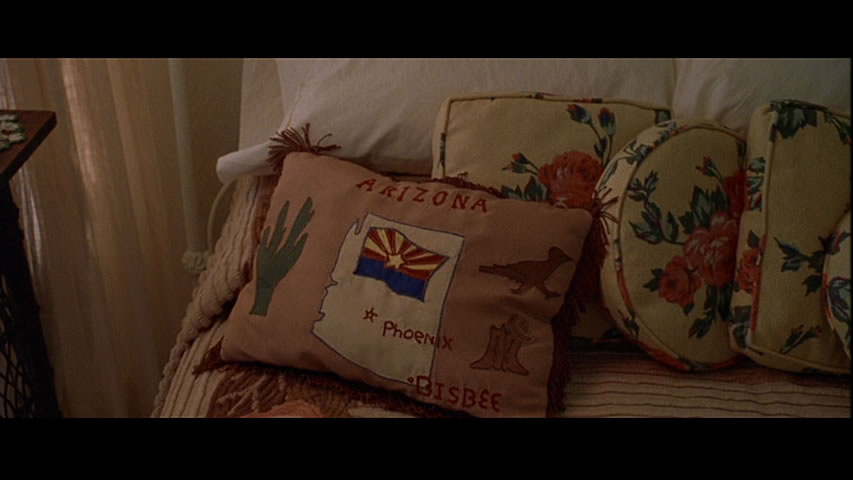
Above are two shots from two different film noir movies. The first is from L.A. Confidential, a neo-noir film from 1997, and the second is from Double Indemnity, a film noir from 1944. A common element in film noir movies is the idea of the purity and innocence of a small town versus the evilness of a big city. Both of these movies toy with this idea.
In the first shot from L.A. Confidential, we see for the first time a picture of Lynn Bracken's room. Prior to this, the film kind of sets her up as a "femme fatale," an evil seductive woman, but here, we see a much different picture. This shot of her bedroom shows us her soft side, with the embroidered pillows, the nice curtains, and the fancy table. This is not the bedroom that you would expect a hooker to have. The most interesting detail of this picture is the Arizona pillow. On this, you can see that the presumably small town of Bisbee, Arizona is labeled, implying that this is her hometown. This gives the viewer the idea that deep down, she is just an innocent small town girl, as opposed to Phyllis from Double Indemnity, who is from Los Angeles.
The shot below, which is a long shot from Double Indemnity, also features a small town person. The man in the middle is from Medford, Oregon. How do we know that? Well, he says it in almost every sentence, so clearly the film makers want us to know that detail. In this shot, he is sitting down and looking up at Mr. Keyes, showing respect. He is dressed formally and is holding a cigar in one hand and paperwork in the other. All these details show is that this guy is trustworthy and well intentioned. Walter Neff, on the other hand, who lives in and is likely from Los Angeles, is standing behind, looking nervous and covering his face. He clearly feels guilty and his hiding something.
These two shots support the notion that living in a big city corrupts people, whereas there is something more pure about being from a small town.
Tuesday, October 23, 2012
The Quitter Section 2: Images
Written Parallel
Harvey says: "But I buckled down to work, boy. I didn't want to embarrass [my father]" (15).
Harvey says: "When my father came to take me to the new place,...I was suddenly embarrassed by him" (7).
As a child, Harvey was embarrassed of his foreign father, but as he matures, he doesn't want to let him down, although he still doesn't agree with his ways.
Visual Contrast
Throughout the novel, I have been noticing a sharp distinction to how black people and white people are depicted in the illustration, and I've found this difference to be borderline racist. On page 5 at the bottom, there is an angry mob of black people who look like savages. Their faces are distorted and they look sort of barbaric. Whereas, on page 28, when Harvey's classmates are complimenting him on his fighting skills, all the "extras" that are white look very respectable and like nice humans.
Images

Harvey says: "But I buckled down to work, boy. I didn't want to embarrass [my father]" (15).
Harvey says: "When my father came to take me to the new place,...I was suddenly embarrassed by him" (7).
As a child, Harvey was embarrassed of his foreign father, but as he matures, he doesn't want to let him down, although he still doesn't agree with his ways.
Visual Contrast
Throughout the novel, I have been noticing a sharp distinction to how black people and white people are depicted in the illustration, and I've found this difference to be borderline racist. On page 5 at the bottom, there is an angry mob of black people who look like savages. Their faces are distorted and they look sort of barbaric. Whereas, on page 28, when Harvey's classmates are complimenting him on his fighting skills, all the "extras" that are white look very respectable and like nice humans.
Images

Here we have a long shot of Harvey in the boys locker room after he beat up a kid. Much like many of the shots we've looked at, the most interesting part of the shot does not happen in the middle frame. Instead, the guy lying on the ground is roughly at the intersection on the bottom right frame (if you can picture a tic-tac-toe grid on the image) and the middle frame is relatively unoccupied. There are people in the middle, but they are in the back and clearly less important. This shot I'd argue is slightly a low angle shot. We can see Harvey's whole body (on the right) but we are below his face so we are looking up at him. This makes him appear bigger and he is towering over the guy on the floor who he just beat up.
Wednesday, October 17, 2012
The Quitter Section 1: Frames
On the third page, Harvey's mother says, "African Americans and Jews should stick together, since we're both persecuted minorities."
Later in the section, Harvey wonders, "Why would she want me to give up just because I was in the minority?"
These quotes both show how important it is to Harvey's mother to not me in the minority. She thinks African-Americans and Jews should side with each other because that will give them more numbers, and she tells Harvey he should join the other side because he is outnumbered.
After watching film noire, a visual parallel that I noticed right away while reading this book was the use of shadows.


Later in the section, Harvey wonders, "Why would she want me to give up just because I was in the minority?"
These quotes both show how important it is to Harvey's mother to not me in the minority. She thinks African-Americans and Jews should side with each other because that will give them more numbers, and she tells Harvey he should join the other side because he is outnumbered.
After watching film noire, a visual parallel that I noticed right away while reading this book was the use of shadows.


In both of the fight scenes shown above, Harvey's opponents are shown only as shadows. This gives the reader the idea that these people are insignificant, nameless people that are dark and mean. They shadow over Harvey in the upper shot, as if them have power over him, but Harvey is grasping and finally beating the shadow in the shot below.
Also, this book features many different shapes and sizes of frames. Visually, the frames that stick out first are the large frames with little text interrupting them. One of the biggest frames in the section is shown above, where the shadows of his opponents stand over Harvey. This is a crucial shot because it shows that Harvey is powerless against the many people, which relates to the written parallel I found that has to do with strength of numbers and minorities. The other biggest frame is Harvey shown covering his ears, trying to block out his Mom's favorite candidate and a communist flag, showing that he doesn't want to hear to opinions of his mother because they are unpopular in American culture.
One interesting thing I noticed the author did with frames was on page 11, the last page we read. This page is divided up into 6 squares and is perfectly symmetrical. Harvey is placed on the right third of the frames on the left, and the left third of the frames on the right, so when you look at them together, It looks like 3 people connected by the frames. This shows two sides of Harvey. On the left side, he is in the dark, angry and his face is bruised, whereas on the right, his face is clean and well lit, and he looks confused. This page shows the effect of how frames can take on a different meaning when they are placed next to each other.
Also, when a page has many small frames, things seem to be going by quicker and it is easier to glance over them, as they are not the most important part. On the other hand, when the frames are big, although there is less text, things seem to move slower.
If I were to make chapters in the book, I'd end the first chapter after Harvey wins a fight and gets accepted into a new group of people because it has a good narrative arc (Harvey is faced with a conflict and he overcomes that conflict). I'd title this section "Minority Race" because it captures the idea that minorities are racing to get out of their situation and join the majority. The African-Americans have done this, as they have found a neighborhood where they could be the majority, and Harvey does this too in the end when he finally fits in.
The next section (that I've made) starts with Harvey asking his mother for advice, but then realizing that she is wrong, and he'd have to do things his own way. All people have this realization that their mother is not always right as they grow up, so I'd title this section "Independence," as he is becoming independent from his mother.
Tuesday, October 9, 2012
Frames

In the picture above, the bunk beds act as a frame to the teddy bear, who lies at the intersection of the top right frame. To the left, there is another character in the background, who seems less important to the scene since he is farther away.

This is a picture taken of my grandparents. While they are in the foreground and are clearly the focus of the picture, I think the background (buildings in Chicago) is just as important. This picture would look way different and send a different message if the background were mountains, or a lake, or a football game.

Here is another picture of my teddy bear, who is placed in the lower right frame of the shot. In the center and everywhere else in the photo is far less interesting, but it provides context that the bear is in its comfortable home.

The teddy bear here is framed between ordinary kitchen items. The bowl of fruit, oven mitt, counter, pot, and television (who doesn't have one of those in their kitchen nowadays?) surround the bear to place him in his own frame.

I love this shot because it shows the teddy bear has power over my dog. This is because this low angle show makes the bear look big. We know it is low angle because in the top third of the picture we can see the cabinets above. The middle frame is relatively unoccupied (just the bear's big forehead), but the real action takes place at in the bottom third where both the dog's and the bear''s face are.

This picture to me is extremely interesting. The whole right third is lit up by lightning. The middle third is dominated by the Sears Tower (or I guess the Willis Tower), which is sort of framed by the other buildings, and in the top left, there is yet another light (the sun). Also, in the bottom left, there is the neon light of a restaurant. Besides that though, the rest of the picture is very gloomy and dark.

This picture to me is interesting because a few of the lines of the 9 frames are drawn by items in the picture like the foul pole and the sign. The sign on top is interesting to me because although it is in the foreground, it is not the most interesting thing in the picture. It just serves as a bearing to let the viewer know that this is the perspective of a fan in the stands.

This picture isn't from this week, but I decided to upload it because it is maybe the coolest picture I have every taken with an iPhone camera. The person is in the top right frame. In the foreground, there is water splashing up from the motor, informing the viewer we are on a boat, and in the back in the top third, there are trees and a house, telling us we are on a small lake.
Sunday, September 23, 2012
What this one shot of Minority Report tells us...

The shot above is a medium shot from the movie Minority Report. It is pretty much straight on (neither high nor low angle).
On the left is Lamar Burgess, who is in the light, suggesting he knows something. Danny Witwer is on the right, but he is in the dark because he does not know the information Burgess knows. The left side of his face (from the camera's perspective), is however slightly lit up, suggesting maybe he is on the verge of uncovering something. This would explain why there is a concerned look on Burgess' face; he is worried that Witwer is close to knowing what he knows because his face is starting to light up.
Another interesting observation is that the background behind Burgess (the left side) is all curved and slanted. Throughout the movie, Spielberg uses circles or round objects to suggest secret or illegal activity, such as murder. For example, the "murder predicting machine" shown in the beginning of the film turns a cubic wooden block into a sphere when a murder is committed. Conversely, on Witwer's side of the room (the right side), everything is perfectly straight and rectangular in the background, or in other words, there are only 90 degree angles, suggesting that he goes by the rules and has nothing to hide.
A last key difference is how each character is dressed. Burgess is wearing his suit jacket, which tends suggest power in film (the higher position you hold, the more formally you will typically dress. It also suggests that maybe he is covering himself up or hiding behind his jacket so nobody can see the real him. Witwer, on the other hand, has clearly taken off his outer suit jacket and not holding anything back.
So, just by looking in depth at the shot and ignoring all other parts of the movie, one can reasonably conclude that Burgess knows something that Witwer doesn't, and he is trying to cover it up because it may be something illegal. This shot is contrast to the previous scenes in the movie, where Burgess is made out to be good and Witwer is made out to be the bad guy. Therefore, I belief it exists to shift the viewers viewpoint and show us the bad side of Burgess because, as it turns out, he did commit a murder that Witwer, now not so much a bad guy, is on the verge of discovering. One can also make extremely different conclusions, but having seen the movie, that's how I'm seeing it.
Thursday, August 30, 2012
Movies I Watched This Summer
At Home:
21 Jumpstreet
Cars (a couple of times)
Dude, Where's My Car?
Minority Report
In Theatres:
Amazing Spiderman
Ted
Of these movies that I've listed above, the one that surprised me most was Ted, a comedy that Seth McFarland of Family Guy wrote, directed, and starred in (or his voice did). I didn't know what to expect when I went to see this movie, but the fact that it starred a living teddy bear made me a little skeptical. I was shocked at how vulgar this film was for a film that features a teddy bear (can you imagine how many little kids begged their parents to talk them to the teddy bear movie?), but it was still surprisingly funny for an adult crowd and had a common real life conflict (keeping friends close as you grow up). So despite the fact that it had a living teddy bear, it was a very funny movie that actually is somewhat realistic (don't we all have a "Ted" that we struggle to move on from as we grow up?).

On another note, the effects in this movie would have been impossible to imagine 10 years ago. It is amazing how they could bring a teddy bear to life in a non animated film without it looking fake.
21 Jumpstreet
Cars (a couple of times)
Dude, Where's My Car?
Minority Report
In Theatres:
Amazing Spiderman
Ted
Of these movies that I've listed above, the one that surprised me most was Ted, a comedy that Seth McFarland of Family Guy wrote, directed, and starred in (or his voice did). I didn't know what to expect when I went to see this movie, but the fact that it starred a living teddy bear made me a little skeptical. I was shocked at how vulgar this film was for a film that features a teddy bear (can you imagine how many little kids begged their parents to talk them to the teddy bear movie?), but it was still surprisingly funny for an adult crowd and had a common real life conflict (keeping friends close as you grow up). So despite the fact that it had a living teddy bear, it was a very funny movie that actually is somewhat realistic (don't we all have a "Ted" that we struggle to move on from as we grow up?).

On another note, the effects in this movie would have been impossible to imagine 10 years ago. It is amazing how they could bring a teddy bear to life in a non animated film without it looking fake.
Thursday, May 31, 2012
Favorite Post
Looking back through all my blogs this quarter, I think my favorite post was the first one I did this quarter, called "The Impact of Trayvon Martin." I did this blog over spring break when I was really just trying to relax and enjoy my time, but I was really intrigued by this Trayvon Martin story and took my time putting out a blog about it.
I think this blog is a great one because it is very well organized: I introduced the topic in an interesting way, provided historical facts and other's reactions to them, and then looked critically at what happened and how people reacted.
One thing in this blog I think I could've analyzed more was the picture. I simply just put it there since that picture was used in a lot of articles I read and used it to just show people what George Zimmerman and Trayvon Martin looked like. Looking at this picture again, it is obvious I could've analyzed more, as this picture clearly tries to make people feel bad for Trayvon. They used a picture of Trayvon when he was a few years younger and innocently smiling as if this was a school yearbook photo. For Zimmerman however, there is a mug shot with him glaring at the camera, looking like a very unfriendly man. I think just by looking at this picture people subconsciously take Trayvon's side, and it could be a big reason he had so many supporters in this case because this picture was so commonly chosen to be in news articles.
I still think though that this blog was very powerful because I start with a specific example of a case that happened and then broaden my lens to look at America as a whole. So, while I believe so many of my blogs are worthy of being read, I would highly recommend you read "The Impact of Trayvon Martin."
I think this blog is a great one because it is very well organized: I introduced the topic in an interesting way, provided historical facts and other's reactions to them, and then looked critically at what happened and how people reacted.
One thing in this blog I think I could've analyzed more was the picture. I simply just put it there since that picture was used in a lot of articles I read and used it to just show people what George Zimmerman and Trayvon Martin looked like. Looking at this picture again, it is obvious I could've analyzed more, as this picture clearly tries to make people feel bad for Trayvon. They used a picture of Trayvon when he was a few years younger and innocently smiling as if this was a school yearbook photo. For Zimmerman however, there is a mug shot with him glaring at the camera, looking like a very unfriendly man. I think just by looking at this picture people subconsciously take Trayvon's side, and it could be a big reason he had so many supporters in this case because this picture was so commonly chosen to be in news articles.
I still think though that this blog was very powerful because I start with a specific example of a case that happened and then broaden my lens to look at America as a whole. So, while I believe so many of my blogs are worthy of being read, I would highly recommend you read "The Impact of Trayvon Martin."
Monday, May 28, 2012
Just the Right Shade?
"You knew at some point, [Barack Obama] was supposed to win. He had all the right ingredients that came together at the right time: he's tall, good looking, articulate, highly intelligent, smooth under pressure, charismatic, and--most importantly--he was the right shade."
This is a quote from stand-up comedian Aries Spears that I came across and was struck by (here is the video, his Obama comments start 13 minutes in). He claims that Obama's perfect skin color allowed him to win, and when I though about it, I agreed with this notion because he was light enough to "make white people feel comfortable" but still "Black" so that Americans can feel like we have progressed enough to elect an African-American president.
If Obama was "Bernie Mac black," I truly don't think he could've been elected, but since he is 1/4 white and has lighter skin, the idea of him as president was a little less radical to people. To use Aries Spears' analogy, he's like "coffee with cream, it goes down easy" as opposed to "coffee black," which is "too strong."
On the other hand, I believe there is another group of Americans that wants to buy into this idea (myth?) that we are no longer a racist country. Therefore, the fact that he was African-American at all helped him.
Obama's skin color was "perfect" because it appealed to both these groups of people: he got every Black person's vote for simply being their skin color and didn't scare too many white people away since he is very light skinned for an African-American.
Is Aries Spears right? Was Obama just the right shade for being president? Would results have been different if he was much darker or lighter?
 |
| Is Obama's relatively light skin color a possible reason he won? |
If Obama was "Bernie Mac black," I truly don't think he could've been elected, but since he is 1/4 white and has lighter skin, the idea of him as president was a little less radical to people. To use Aries Spears' analogy, he's like "coffee with cream, it goes down easy" as opposed to "coffee black," which is "too strong."
On the other hand, I believe there is another group of Americans that wants to buy into this idea (myth?) that we are no longer a racist country. Therefore, the fact that he was African-American at all helped him.
Obama's skin color was "perfect" because it appealed to both these groups of people: he got every Black person's vote for simply being their skin color and didn't scare too many white people away since he is very light skinned for an African-American.
Is Aries Spears right? Was Obama just the right shade for being president? Would results have been different if he was much darker or lighter?
Tuesday, May 22, 2012
Need for Violence
A couple days ago, protestors came to Chicago because there was a North Atlantic Treaty Organization (NATO) conference taking place with a lot of the world's leaders. What I found particularly interesting was how the media covered this event. I flipped through multiple news channels during this time that were all covering the protestors, but not one mentioned what was taking place at the conference or what the protesters were protesting. The only thing that was ever covered was the violence, or lack of violence for that matter, that occurred. For example, take a look at this snapshot of the CNN coverage below:

Almost every other news station, like CNN, mentioned and tried to cover some sort of "clash" that took place between the police and the protesters, and then after is was all done and they realized there wasn't any violence to report, they'd all say, "Well the Chicago police did a very good job," seeming slightly disappointed that they couldn't make a big story out of it as they clearly planned to do.
This type of news coverage didn't just occur during this event, it always happens. All the time, the news reports violence only without ever really telling the reasons behind it like they did here. What was the NATO Conference for? What were these people protesting? To be honest, I still don't really fully understand despite looking and asking people, and nobody can tell me for sure what this is all about. All I've heard is that the police did a great job preventing violence because that's all the news will ever say.
Why is there this need for violence? Should news stations report the general information even if it's less exciting?
Thursday, May 17, 2012
America's Arc
One of the proposed titles for the film Citizen Kane, a film many critics claim to be the best film ever, was The American. Without question, the main character Charles Foster Kane is "the American" they were referring to because his life represents not the common American life, or even the ideal American life, but the country itself.
 The United States of America began when the castaways from Europe rose up to defeat the great British army to gain their independence. They began as a country of people who didn't know much about being in power, but knew that they wanted to have certain ideals that they illustrated in the Declaration of Independence.
Charles Foster Kane was very similar. He didn't fight for his fortune, but he did come from nothing but was then somehow selected to inherit a great fortune. At a young age, he took over a newspaper company, and on his first day, he created his "Declaration of Principles", which were promises that he would not be corrupt and deliver unbiased news, which the public deserved. However, when he signs this declaration, he is in a shadow, showing that he is "in the dark" about what is to come.
Much like Charles Foster Kane, America rose and became among the most powerful forces in the world because that's what they desired and felt they deserved. However, Kane begins to lose everybody's support when he refuses to make amends for others. For example, when his opponent in the race for governor threatens to expose his affair to the public, he stays in the race despite not having much of a chance rather than backing out to protect his image and his family. He does this because he is convinced that he is the best and nobody can do anything to him.
I find this to be the mindset of America as a country as well. America has plenty of power in the world, so they believe their way is the only way and refuse to make amends for others because of their ego, much like Kane. One example of this in American history is the decision to drop atomic bombs on Hiroshima and Nagasaki to end WWII because they felt risking 30,000 American lives in an invasion (which nobody denies would have been successful) was not worth it when they could just kill hundreds of thousands of innocent Japanese people. America did this because they truly believed they were better and that their lives meant more.
America's narrative arc thus has been identical to Kane's through his early years: start from nothing, but then gain power but promise to retain ideals, which are later tossed aside as they are corrupted by having too much power and by things they couldn't see coming. America has not yet encountered the complete downfall Kane did at the end of his life with no real relationships, but perhaps this movie was predicting it?

Charles Foster Kane was very similar. He didn't fight for his fortune, but he did come from nothing but was then somehow selected to inherit a great fortune. At a young age, he took over a newspaper company, and on his first day, he created his "Declaration of Principles", which were promises that he would not be corrupt and deliver unbiased news, which the public deserved. However, when he signs this declaration, he is in a shadow, showing that he is "in the dark" about what is to come.
Much like Charles Foster Kane, America rose and became among the most powerful forces in the world because that's what they desired and felt they deserved. However, Kane begins to lose everybody's support when he refuses to make amends for others. For example, when his opponent in the race for governor threatens to expose his affair to the public, he stays in the race despite not having much of a chance rather than backing out to protect his image and his family. He does this because he is convinced that he is the best and nobody can do anything to him.
I find this to be the mindset of America as a country as well. America has plenty of power in the world, so they believe their way is the only way and refuse to make amends for others because of their ego, much like Kane. One example of this in American history is the decision to drop atomic bombs on Hiroshima and Nagasaki to end WWII because they felt risking 30,000 American lives in an invasion (which nobody denies would have been successful) was not worth it when they could just kill hundreds of thousands of innocent Japanese people. America did this because they truly believed they were better and that their lives meant more.
America's narrative arc thus has been identical to Kane's through his early years: start from nothing, but then gain power but promise to retain ideals, which are later tossed aside as they are corrupted by having too much power and by things they couldn't see coming. America has not yet encountered the complete downfall Kane did at the end of his life with no real relationships, but perhaps this movie was predicting it?
Sunday, May 13, 2012
Are we still racist in voter registration?
Many people have heard of specific laws and literacy tests that prevented southern African-Americans from voting before the Civil Rights Movement, but most people are unaware of what Andrew Hacker calls the subtle laws that prevent minorities from voting today.
Hacker argues that by requiring formal photo identification such as a driver's license or passport to vote (as states have recently began to do), they are preventing African-Americans and other minorities, who are much less likely to have one of these government-issued documents, from voting.
Hacker specifically studies the city of Milwaukee, Wisconsin, where over 53% of the black population is unlicensed, compared to only 15% of whites who don't have a license. These numbers are similar across the country, he claims. It is technically possible for unlicensed people to still get another permitted form of identification, but oftentimes African-Americans and other minorities, who are typically much more disadvantaged, do not have the resources to retrieve one of these pieces of identification.
The Help America Vote Act of 2002 is another way African-Americans are being prevented the right to vote. This act requires states to keep track of their voters, and to do that they would send out letters to all their voters, and cross off the people they could not find. The people that were crossed out lived in "mostly urban and minority areas" because these people tend to move more often or not have a permanent address, and thus preventing people in these areas from voting.
Of course, all these laws are justified by the fact that it prevents fraud, which it does, but it also prevents a lot of people, especially minorities, from voting.
Why does the government make these laws? Are they really that interested in preventing fraud which could help them or are they trying to eliminate a group of voters like Hacker suggests? Are these laws fair? Are there any alternative solutions?
Hacker argues that by requiring formal photo identification such as a driver's license or passport to vote (as states have recently began to do), they are preventing African-Americans and other minorities, who are much less likely to have one of these government-issued documents, from voting.
Hacker specifically studies the city of Milwaukee, Wisconsin, where over 53% of the black population is unlicensed, compared to only 15% of whites who don't have a license. These numbers are similar across the country, he claims. It is technically possible for unlicensed people to still get another permitted form of identification, but oftentimes African-Americans and other minorities, who are typically much more disadvantaged, do not have the resources to retrieve one of these pieces of identification.
The Help America Vote Act of 2002 is another way African-Americans are being prevented the right to vote. This act requires states to keep track of their voters, and to do that they would send out letters to all their voters, and cross off the people they could not find. The people that were crossed out lived in "mostly urban and minority areas" because these people tend to move more often or not have a permanent address, and thus preventing people in these areas from voting.
Of course, all these laws are justified by the fact that it prevents fraud, which it does, but it also prevents a lot of people, especially minorities, from voting.
Why does the government make these laws? Are they really that interested in preventing fraud which could help them or are they trying to eliminate a group of voters like Hacker suggests? Are these laws fair? Are there any alternative solutions?
Subscribe to:
Posts (Atom)